
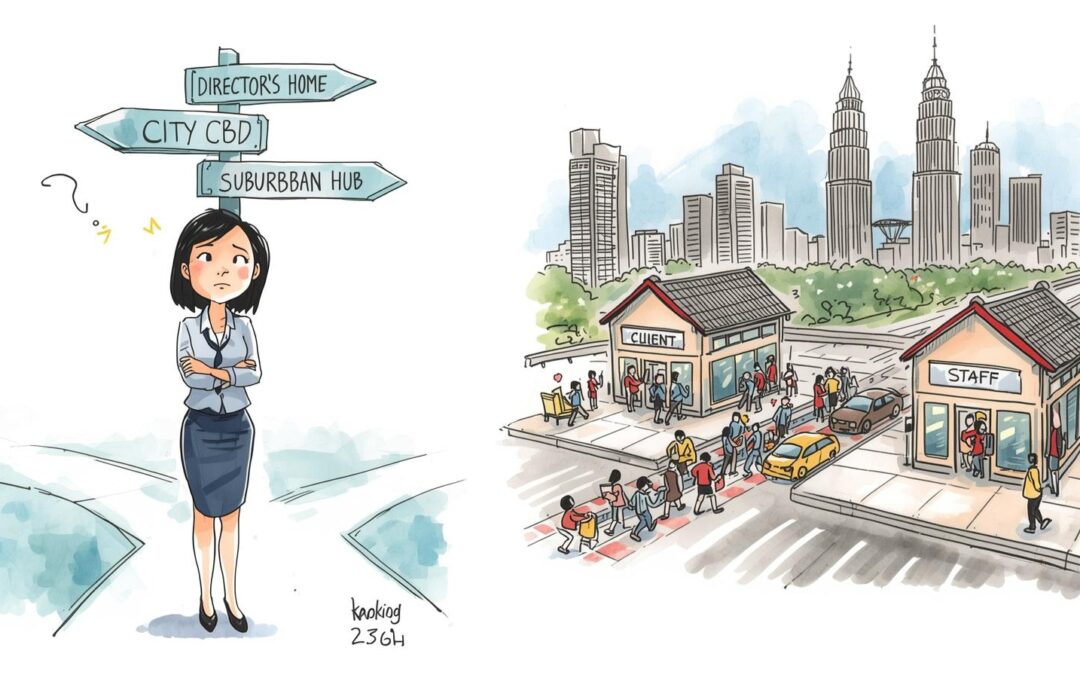
The Director's Ultimate Guide to Office Selection in Malaysia: Beyond the Trilemma
Choosing a new office is one of the most consequential decisions a business leader will make. It’s far more than a line item on the balance sheet; it’s a strategic, long-term commitment that will profoundly shape your company culture, operational efficiency, brand perception, and, critically, your ability to win the war for talent.
In Malaysia, this decision is amplified. We are defined by our vibrant, sprawling suburbs, our prestigious city centres, and the one universal challenge that binds us all: traffic.
For decades, the decision often boiled down to a "trilemma"—a difficult choice between three priorities:
- Yourself (The Director)
- Your Customers
- Your Employees
But in today's post-pandemic, digitally-driven economy, the framework is far more complex. The "right" location is no longer just about these three stakeholders. It’s a sophisticated matrix of mobility, logistics, internal productivity, branding, and flexibility.
This guide will walk you through the old trilemma, introduce these critical new factors, and help you build a decision framework that truly serves your business.
Part 1: The Core Conflict — The People Trilemma 🧑💼🤝👩💻
First, let's analyse the classic three hubs. Who are you optimising for?
Model 1: The Director-Centric Hub (The "Control Centre")
This is the traditional SME model, often an unconscious default. The logic is, "I am the director. My time is the most valuable. The office must be convenient for me." This often means an office located just 10 minutes from your home.
-
Pros: High director productivity, quick oversight, and personal convenience.
-
Cons: Restricts your talent pool to only those willing to commute to your preferred area. It can be perceived as self-serving and build resentment, especially if their own commutes are over an hour.
-
Best for: One-person-shows or early-stage startups where the founder is the entire operation.
-
🚨 The Extreme & Ineffective: The 'Work-from-My-Home' Model A worrying trend is the "director-centric" model taken to its extreme: the director forgoes an office entirely and asks staff, particularly admin staff, to come to their private home for work or meetings.
This is not a "home office" or "flexible work" model; this is a false economy. A private residence is not a professional workplace.
-
It is not a conducive environment: A home is filled with personal distractions and lacks the proper ergonomic and professional setup.
-
It blurs professional boundaries: It puts the employee in a deeply awkward position, blurring the lines between a professional employee and a personal assistant.
-
It creates legal and security risks: It opens a minefield of liability and risks the security of confidential company documents.
-
Model 2: The Customer-Centric Hub (The "Prestige Showroom")
The logic here is, "We must be where our customers are." This means a premium, "Grade A" office building in a prestigious central business district (CBD) like KLCC, TRX, or the prime areas of Bangsar.
-
Pros: High brand perception, client convenience, and strong networking opportunities.
-
Cons: Highest cost (rent and parking). Often a terrible commute for staff, leading to burnout.
-
Best for: Financial institutions, top-tier law firms, or any B2B business where brand image and high-stakes, in-person meetings are fundamental.
Model 3: The Employee-Centric Hub (The "Talent Magnet")
This is the modern, post-pandemic model. The logic is simple: "Our people are our greatest asset. We win by attracting and retaining the best talent. Therefore, we must make their lives easier."
This often means a decentralised location in a major suburban hub like Petaling Jaya, Subang Jaya, or a well-connected area like Mont Kiara.
-
Pros: Massive advantage in talent acquisition and retention. Higher employee morale, better work-life balance, and often lower costs.
-
Cons: May be inconvenient for the director and feel less "prestigious" for high-end clients.
-
Best for: Tech companies, creative agencies, and any business that competes fiercely for skilled professionals.
Part 2: The Mobility Factor — Who Actually Travels? 🚗💨
Now, we must overlay a crucial strategic filter. Your office location choice changes dramatically depending on who is out of the office.
Scenario A: Your Team Travels Regularly (The "Field Team")
This applies to your engineers, on-site accountants, and product-selling salespersons.
-
The Logic: If your key employees are at client premises most of the day, their "commute to the office" becomes less important. The office is a "base camp" for admin, team meetings, and hot-desking, not a 9-to-5 destination.
-
Strategic Implication: This reduces the priority of the Employee-Centric (Model 3) hub. You might be better off with a Customer-Centric (Model 2) location, as it puts your team closer to your client cluster. Or, you may choose a location based on highway access—a spot near the NKVE, Federal Highway, or LDP—that allows your team to disperse to client sites quickly, bypassing central traffic.
Scenario B: The Director Travels Regularly (The "Road Warrior")
-
The Logic: If you, the director, are the primary salesperson and are constantly out meeting clients, the "Director-Centric" model changes.
-
Strategic Implication: "Convenience for me" is no longer "near my home." It’s "near the airport (KLIA/Subang)" or "near major highway arteries." A location that gives you a 30-minute head start to the airport or the city centre is more valuable than one that's 10 minutes from your bed but 40 minutes from the highway.
Scenario C: Everyone is In (The "Deep Work" Hub)
-
The Logic: This applies to developers, designers, writers, internal finance, and support teams who need to be at their desks to be productive.
-
Strategic Implication: This makes the Employee-Centric (Model 3) location your highest priority. Furthermore, it means Part 4 (Internal Environment) becomes the most critical factor in your entire decision.
Part 3: The Practical & Physical Filters
Once you've leaned towards a "people" and "mobility" model, you must filter it through these practical realities.
-
🚗 Parking: The Silent Culture Killer In Malaysia, a lack of parking, or expensive parking, is a daily financial and mental drain. An office with no parking, or where a season pass costs RM300, is a "hidden tax" on your employees. If you are not on a direct transit line, ample, affordable, or subsidised parking is a critical retention tool.
-
🚆 Transportation Hub & Daily Travelling Time This is the great equaliser. Being "near an LRT/MRT" means a safe, covered, 5-10 minute walk to the station. This single factor exponentially widens your talent pool. When scouting, physically time the walk from the station to the office door.
-
🍜 Amenities: The "Ecosystem" of Food & Coffee An office is not an island. Your staff need access to a variety of food, from affordable 'warung' or food court options to a mid-range cafe. And you, the director, need a "third place" nearby—a good coffee house—to hold informal client meetings or for staff to decompress.
Part 4: The Internal Environment — Space, Noise & Productivity 🖥️🎧
The location gets them in the door. The internal environment determines if they can actually do their jobs. A cheap, cramped office will destroy the productivity you gained from a good location.
- Deep Work & The Individual Desk Modern work, especially for tech, finance, or design roles, often requires multi-display computer monitors. This is not a luxury; it's a productivity tool. This demands physical space—a desk that is wide and deep enough. A "close sitting environment" or a narrow, cramped desk makes this impossible, frustrating your most skilled workers and killing their efficiency.
- Collaboration: The "Conducive Meeting" Ideas are exchanged in two ways: formal and informal. You must have space for both. This means a proper, enclosed meeting room for confidential, structured discussions. It also means an "idea-exchange" space—a corner with a whiteboard, a small lounge area—where a conducive internal meeting can happen spontaneously without a formal booking.
-
The Acoustic Privacy Crisis This is the number one killer of open-plan offices. In an age of endless online video calls (Teams, Zoom, Google Meet), a "close sitting environment" is a disaster.
- The Problem: One person on a call creates unnecessary noise for everyone around them. This "audio pollution" breaks the concentration of all peers and colleagues.
- The Symptom: When you see staff "need to move out of [their] working desk"—fleeing to the pantry, a corridor, or even the 'surau' to take a call—you have a failed office design.
-
The Solution: You must invest in acoustic privacy. This means either:
- Phone Booths: Small, soundproof pods for single-person calls.
- Quiet Zones: A dedicated area of the office where no calls or talking are allowed.
-
Partitioned Offices: Returning to smaller, private offices for teams of 2-4 people.
Part 5: The Operational & Logistic Essentials
These are the "nuts and bolts" that business owners often forget until it’s too late.
-
📦 Logistics: Parcels, Mail & Moving
-
Parcel Convenience: Is there a dedicated mailbox area? More importantly, is there a ParcelHub, J&T, or other logistics drop-off point nearby? This is a massive operational timesaver.
-
Lift Access: Is there a dedicated service lift? If you are moving heavy documents, product inventory, or even just office furniture, trying to use a crowded passenger lift is a nightmare.
-
-
🌟 Visibility: Frontage & Signboard
-
Shop Frontage: If you need walk-in traffic, a ground-floor unit is critical.
-
Signboard Space: If you’re in a tower, where can you put your name? Is it just a tiny entry in a lobby directory, or do you have a right to a visible signboard?
-
-
☯️ The "Feel": Unit Condition & Feng Shui
-
New vs. Previously Tenanted: A brand-new unit is a customisable "blank canvas" but means a heavy fit-out cost. A tenanted unit is faster to move into, but you inherit its problems.
-
Feng Shui: For many in Malaysia, this is a non-negotiable. It's about ensuring a positive flow of 'qi' (energy) for prosperity. If this is important to you, bring your 'sifu' (master) before you sign the tenancy agreement.
-
Part 6: The Strategic Disruptor — No Office at All?
What if the best way to solve the trilemma is to refuse to play?
-
💡 The Serviced & Virtual Office (Regus, WeWork, Common Ground) This model, offered by companies like Regus, provides a powerful alternative.
-
Virtual Office: For a small monthly fee, you get the Customer-Centric (Model 2) benefit. You can have a premium KLCC mailing address and mail-handling services, while your team works from home or a suburban hub.
-
Serviced Office: This is the ultimate "flexibility" play. You get a fully-furnished office in a prime location. All your problems are solved: internet, reception, mail, and—crucially—meeting rooms and phone booths are all included. It's the perfect solution for teams with high mobility (Part 2) or for those testing a market.
-
Conclusion: Your Decision Scorecard
There is no single "perfect" office. The "right" choice is a deliberate compromise that reflects your business's unique priorities.
Stop thinking in terms of "what’s best" and start thinking in terms of "what are we optimising for?"
My advice: Create a Decision Scorecard.
- List every criterion from this article that matters to you.
- Assign a "weighting" to each one (e.g., "Employee Retention" = 10 points, "Internal Acoustic Privacy" = 8 points, "Client Prestige" = 5 points).
- Tour your top 3 potential locations and score them honestly.
An office designed purely for the director's convenience is a relic. An office designed just for client prestige is a luxury. An office designed to attract, retain, and make your people productive is a strategic necessity.
