
Mastering Your Financial Foundation: The Ultimate Chart of Accounts Blueprint 📐
When setting up your Bukku Cloud Accounting system, establishing an accurate Chart of Accounts is the single most crucial step. This system serves as the backbone of your bookkeeping, ensuring every transaction is properly recorded, categorised, and reported. A well-designed Chart of Accounts is fundamental for regulatory compliance and effective financial management, allowing you to prosper! 💡
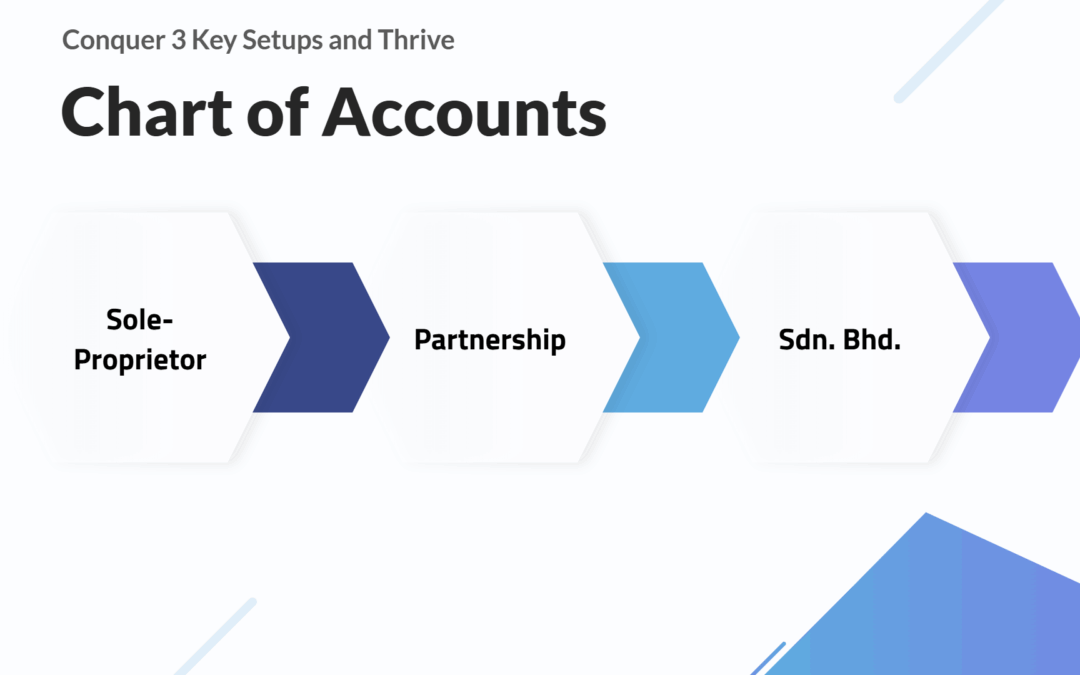
At LTT Outsourced CFO, we tailor your Chart of Accounts structure based on your specific legal entity. The compliance and reporting requirements for a Sole Proprietor, Partnership, and Private Limited Company (Sdn. Bhd.) require different approaches to the Chart of Accounts setup.
Let’s examine the essential categories for each structure. 👇
1. 🧾 Achieving Financial Clarity: The Sole Proprietor's Winning Chart of Accounts
Sole Proprietor accounts are straightforward, but clarity is paramount. The primary goal of this Chart of Accounts structure is to strictly separate business funds from personal use.
| Chart of Accounts Category | Purpose | Key Accounts |
| 💰 Revenue | Income generated from sales of goods or services. | Sales of Goods, Service Income. |
| 💸 Expenses | Routine operational costs. | Office Supplies, Rental, Utilities, Staff Wages. |
| 🧍♂️ Owner's Drawings | Funds or assets the owner withdraws for personal expenditure. | Owner's Drawings, Personal Tax Payment. |
| 📦 Assets & Liabilities | Resources owned and obligations owed by the business. | Bank Account, Petty Cash, Equipment, Creditors, Loans. |
Using this simplified Chart of Accounts structure in Bukku helps ensure business spending is clearly segregated from personal usage, providing a transparent view of the company’s financial performance. 👍
2. 🤝 Optimising Profit Sharing: The Partnership Chart of Accounts Essential
Partnership accounts must accurately reflect the financial relationship between partners, making the Chart of Accounts key for tracking individual contributions and entitlements.
| Chart of Accounts Category | Purpose | Key Accounts |
| 💼 Capital Accounts | Each partner's initial and long-term investment in the business. | Partner A - Capital, Partner B - Capital. |
| 💰 Current Accounts | Tracks short-term partner transactions and entitlements. | Partner A - Current Account (Withdrawals, Salary, Interest). |
| 📊 P&L Appropriation | The mechanism used to legally distribute profits or losses. | Distribution of Profits/Losses. |
| 💸 Operating Expenses | General administrative and operating costs. | Marketing, Admin Salaries, Utilities. |
Bukku’s flexible Chart of Accounts allows for the creation of dedicated accounts for each partner, streamlining year-end reporting and profit allocation for all stakeholders.
3. 🏢 Securing Compliance and Growth: The Sdn. Bhd. Mandatory Chart of Accounts
Sdn. Bhd. entities are highly structured and must comply with the Companies Act 2016 and relevant accounting standards (MPERS/MFRS). Your Chart of Accounts must be robust enough for external audits and strict statutory reporting, ensuring smooth operations.
| Chart of Accounts Category | Purpose | Key Accounts |
| 💰 Share Capital | Funds contributed by shareholders. | Ordinary Shares, Preference Shares. |
| 💵 Revenue & Cost of Sales | Tracking sales and the direct cost incurred to achieve those sales. | Sales Income, Cost of Sales. |
| 🧾 Operating Expenses | All running costs, often broken down by function or department. | Administration Expenses, Sales & Marketing Costs, Finance Charges. |
| 🏦 Balance Sheet Items | The company’s financial position at a given time. | Receivables, Payables, Loans, Tax Payable. |
| 🧮 Retained Earnings | The cumulative net profit or loss of the company retained over its operational life. | Retained Earnings. |
With Bukku, the advanced structure of your Chart of Accounts enables easy grouping and reporting in real-time, empowering directors and shareholders to make quick, informed decisions for sustained growth. 🚀
💰 Unlocking Profit Potential: Advanced Chart of Accounts Expense Analysis
An effective Chart of Accounts facilitates deep financial analysis, allowing you to break down expenses based on their function, behaviour, and location. This is the power behind great financial control.
1. Direct vs. Indirect Expenses: The True Profit Check 🔎
This classification is essential for accurately calculating Gross Profit and Net Profit.
- 📈 Direct Expenses (Cost of Sales): Costs that are directly attributable to the production of goods or delivery of a specific service.
- Examples: Raw Materials, Wages for production staff, Subcontractor Fees, Freight Inwards.
- 📉 Indirect Expenses (Operating Overheads): Costs incurred to operate the business, but not directly tied to the creation of a specific product or service.
- Examples: Office Rental, Administrative Salaries, Audit Fees, Utilities (General Office Use), General Marketing.
2. Fixed vs. Variable Costs: Strategic Budgeting 🎯
Understanding how costs react to changes in sales volume is crucial for budgeting, pricing strategy, and break-even analysis.
- 📉 Variable Costs: These costs change in direct proportion to the level of business activity or sales volume.
- Examples: Sales Commission, Product Packaging, Delivery Fees.
- 📈 Fixed Costs: These costs remain relatively constant over a given period, regardless of production or sales volume.
- Examples: Monthly Office Rent, Annual Insurance Premiums, Fixed Management Salaries, Depreciation Expense.
3. Tracking by Branch, Outlet, or Project: Performance Analysis 📍
For organisations operating multiple units, segregating costs within the Chart of Accounts is critical to determine the true performance and profitability of each individual unit.
- The Method: The most efficient way is using Cost Centres or Tracking Categories within your accounting system (like Bukku). You use the single, main expense code (e.g., 6100: Office Rental) and assign a Tracking Tag (e.g., "Sunway Outlet" or "Project Alpha").
- The Benefit: This enables you to generate a separate Profit & Loss Report for every Cost Centre, providing valuable data for Unit Economics analysis and strategic resource allocation. Using the Chart of Accounts in this way ensures maximum clarity. 👍
4. Personal Expenses: Maintaining Legal Integrity 🙅♀️
For statutory and regulatory compliance, the strict separation of business and personal finances is mandatory, which is facilitated by the structure of your Chart of Accounts.
- The Rule: Personal expenses should never be run through the business’s Operating Expense accounts.
- The Solution (Sole Proprietor/Partnership): Use the Owner's Drawings or Partner's Current Account (an Equity account) to record any personal withdrawals of business funds.
- The Solution (Sdn. Bhd.): Company funds must only be used for legitimate business purposes. Directors receive compensation via Salary or Director's Fee (Operating Expenses) or Dividends (Profit Distribution).
Our Final Word: Mastering these advanced classifications within your Chart of Accounts structure moves you from simple recording to proactive financial management, empowering you to make data-driven strategic decisions and achieve your business goals. 🌟

Trackbacks/Pingbacks